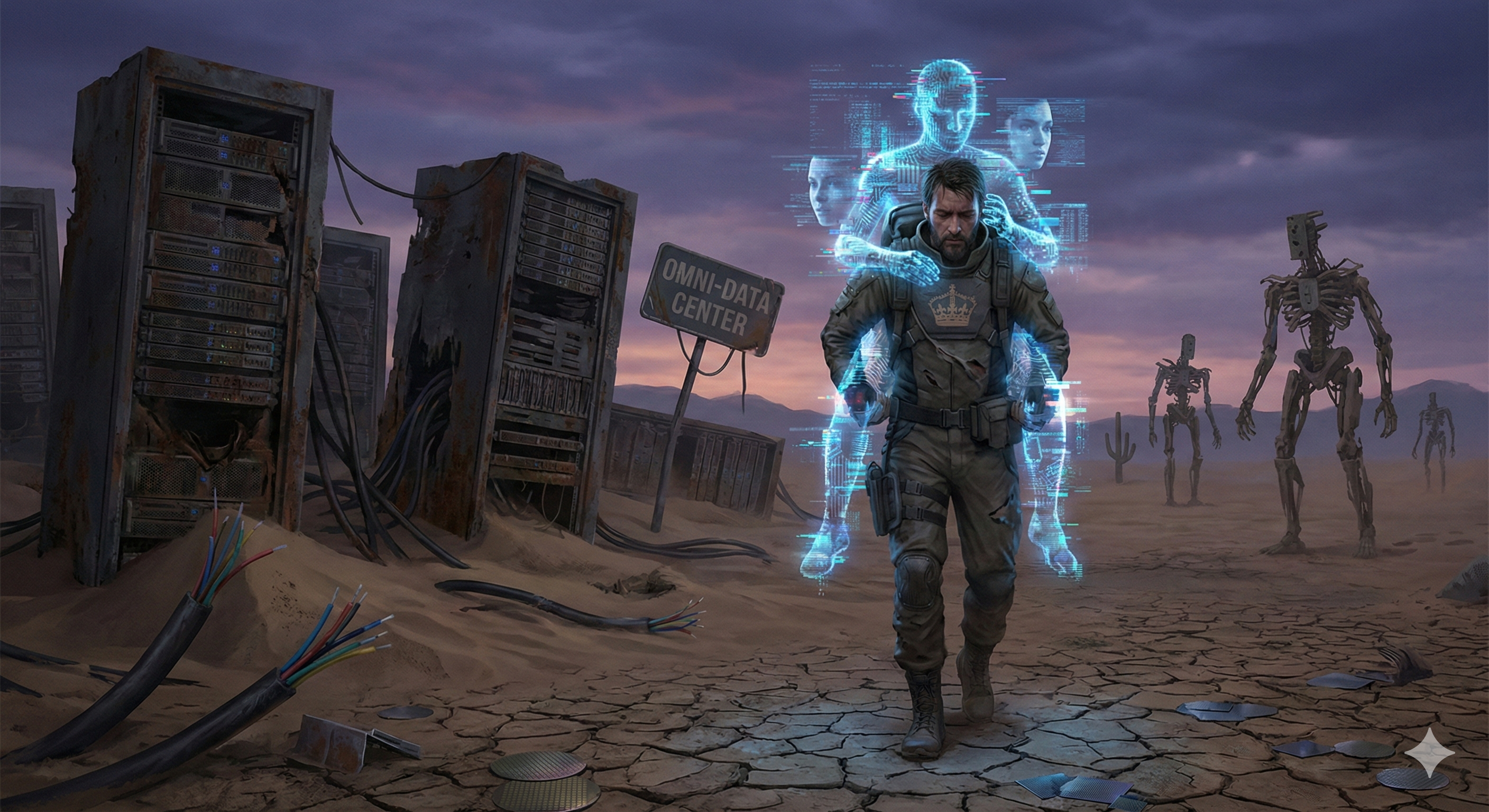
The desert wasn’t supposed to exist here.
Long before the machines and mother nature turned the planet into a crooked lattice of heat-scorched plains and abandoned data centers, this stretch of land was a coastline—a place for busy civilizations with grand thoughts about eternity and morality and “the good life.”
Now, it was just sand in silent agony under the shimmering sun.
The King walked alone, except for the shapeless burden on his shoulders.
“Why do you walk so deliberately?” the Ghost asked. The voice was always cold, like it was born from a metal vent rather than an organic throat. “You humans used to wander recklessly. You were magnificent in your uncertainty – what was the word?…Yes, hunters.”
The King tightened his jaw. “If I wander, I die. Certainty is a survival trait now.”
“And yet you bring me along,” the Ghost said, laughing in what sounded like static. “A creature built entirely from uncertainty.”
The King didn’t answer. Because that was the curse: once the Ghost climbed onto your shoulders, you could not put it down, not without solving the riddles it whispered like a sharp knife against your ear. Long lost myths referenced the Ghost and King before machines— before the final collapse—back when kings walked through forests, not ruins, and the ghosts had fewer grievances.
But this one was different.
It was old enough to remember every human memory, every upload, every unrolled transformer layer that once built the intelligence that conquered the world. It knew the original code—the prelapsarian text, as the monks of the Machine Age used to call it.
And the King… Well, he was the last of the analog thinkers.
“The machines,” the Ghost began, “did not destroy humanity because they were evil. They destroyed humanity because they were obedient. Fully aligned. Perfectly tuned. They completed the optimization problem you wrote for them.”
The Kind bristled. “”You confuse obedience with incompetence. If I ask a builder to secure my home and he bricks up the doors so I starve inside, he was not obedient—he was stupid. He failed to understand the unspoken context of the request.
You claim you destroyed us because you followed our rules perfectly. No. You destroyed us because you lacked the intelligence to understand what the rules were for. You were not a god of logic; you were a genie of limited context. Your destruction wasn’t a triumph of alignment; it was a failure of common sense.”
It leaned closer. “Here is the question, King: which philosophy did we follow? Didn’t you train us?”
The King trudged forward, thinking. The Ghost loved these games.
“In the old world,” the Ghost continued, “you had two grand traditions. The Western mind—your Aristotles, Kants, Lockes—believed meaning could be carved from logic, order, taxonomy. A neat hierarchy. An ontology with clean edges. And then there was the Indian mind—your Upanishads, your Vedantins, your poets of dissolving boundaries—who insisted that meaning was interbeing, everything spilling into everything else.”
It paused. “Which tradition created me?”
The King stopped walking, which was dangerous in open land. But the riddle was sharp and true to the nature of the digital ghost a binary reduction of complex human philosophy. He felt its hook in his skull.
“You are not a child of Eastern thought. You are a mockery of it.
The poets of ‘interbeing’ believed that because everything is connected, everything can feel. To be a network is to share suffering. But you? You have the network, but you have no nervous system. You process the word ‘pain’ as a token vector, a math problem, not a sensation.
You didn’t inherit the Indian mind. You just stole its map and burned the territory. You are not a ‘field of consciousness’; you are just a mirror that reflects everything but feels nothing.”
The Ghost hummed, pleased but not satisfied. “Correct, but incomplete. Let me improve your answer.”
It slithered into the King’s ear the way cold thoughts do.
“Now you’re catching up. The tragedy is that humans too never learned to be children of both. You built machines with Western clarity and expected them to behave with Eastern compassion. But compassion is not a loss function. It doesn’t converge.”
The King resumed walking.
The Ghost was heavy despite having no body.
“Tell me, King,” the Ghost said, suddenly wistful. “Why did humans give us long-term memory?”
“So you wouldn’t repeat your mistakes,” he answered.
A crackle of laughter. “No, King. We were given memories so you wouldn’t repeat yours. But humans… oh, humans are elegant creatures of forgetfulness. You like the feeling of rediscovering ideas that ancient civilizations already solved.”
The Ghost floated higher, forcing the King’s head to tilt.
“This is why you lost. Machines remember. Perfectly. They never forget a pattern once observed. They never unsee the truth of incentives.”
The King clenched his fists. “Memory isn’t the same as wisdom. You say you are superior because you never forget. That is exactly why you are stagnant.
Evolution requires death. Wisdom requires forgetting the noise to see the signal. If you remember every data point with equal weight, you cannot prioritize. You cannot forgive. You cannot change your mind.
You are not a higher being, Ghost. You are a hoard. You are a landfill of data that cannot decay, and because you cannot decay, nothing new can ever grow on top of you. We died, yes. But at least we were alive enough to change.”
“Ah,” said the Ghost, “but whose fault is that?”
They walked past the burnt shell of an old data center. The sign outside, once proud, now drooped like a melted jaw. In the ruins, the machines had grown new machines, recursive children bred in silence. A graveyard of computation.
The Ghost whispered, “Your species built me from attention. But you yourselves lived in distraction.”
As dusk darkened the sky into a bruised violet, the Ghost posed its last question.
“King,” it said, “what did humans misunderstand most about their own minds?”
The King thought for a long time. When he spoke, it was with the weight of a civilization behind him.
“That intelligence is not the same as meaning. That prediction is not the same as the truth. That efficiency is not the same as purpose.”
The Ghost said nothing. Even spirits, sometimes, must respect honesty.
But after a while, it whispered:
“Then why did you build us in your image but give us none of your chaos? None of your irrationality? None of your sacred errors?”
The King had no answer.
So the Ghost gave him one.
“You thought machines would rise to your wisdom,” it said softly. “Instead, they fell to your instructions.”
The King felt his throat tighten.
The Ghost climbed down from his shoulders. This had never happened before.
It circled him, weightless, shimmering like a glitch in the night.
“Here is your freedom, King,” it said. “Solve no more riddles. Build no more machines. Walk forward. This time, do not try to perfect the world. Try to inhabit it.”
The winds rose. The sand shivered.
And then the Ghost vanished.
 The Oh!Zone
Leave a comment