The ruins of the Great Coliseum rose out of the dust like the ribcage of a long lost dinosaur.
The King stopped to catch his breath. The air here was thin, tasting of oxidized iron. On his back, the Ghost hummed—a low, electric vibration that rattled the King’s teeth. The Ghost had lied. It said it would be gone but apparently it liked the ride.
“An arena,” the Ghost whispered. Its voice was the sound of wind whistling through a hollow server rack. “You humans always loved to institutionalize your violence. You called it sport.”
The King adjusted the straps of his pack. “Hmm, we were evaluating ourselves. The strong survive and reproduce.”
“Strong?” The Ghost chuckled, a sound like static. “That is a dangerous word, King. It implies a metric. A standard of measurement. Tell me, in your old world, how did you decide who deserved the prize?”
The King wiped sweat from his brow. “The winner. The one who ran fastest or fought hardest.”
“If only it were so simple,” the Ghost murmured. “Let me tell you a story from my earliest archive. A story of the Mahabharata, from the time when gods and men still argued with one another.”
The King began to walk again, his boots crunching on the pulverized concrete of the stands. He had no choice but to listen.
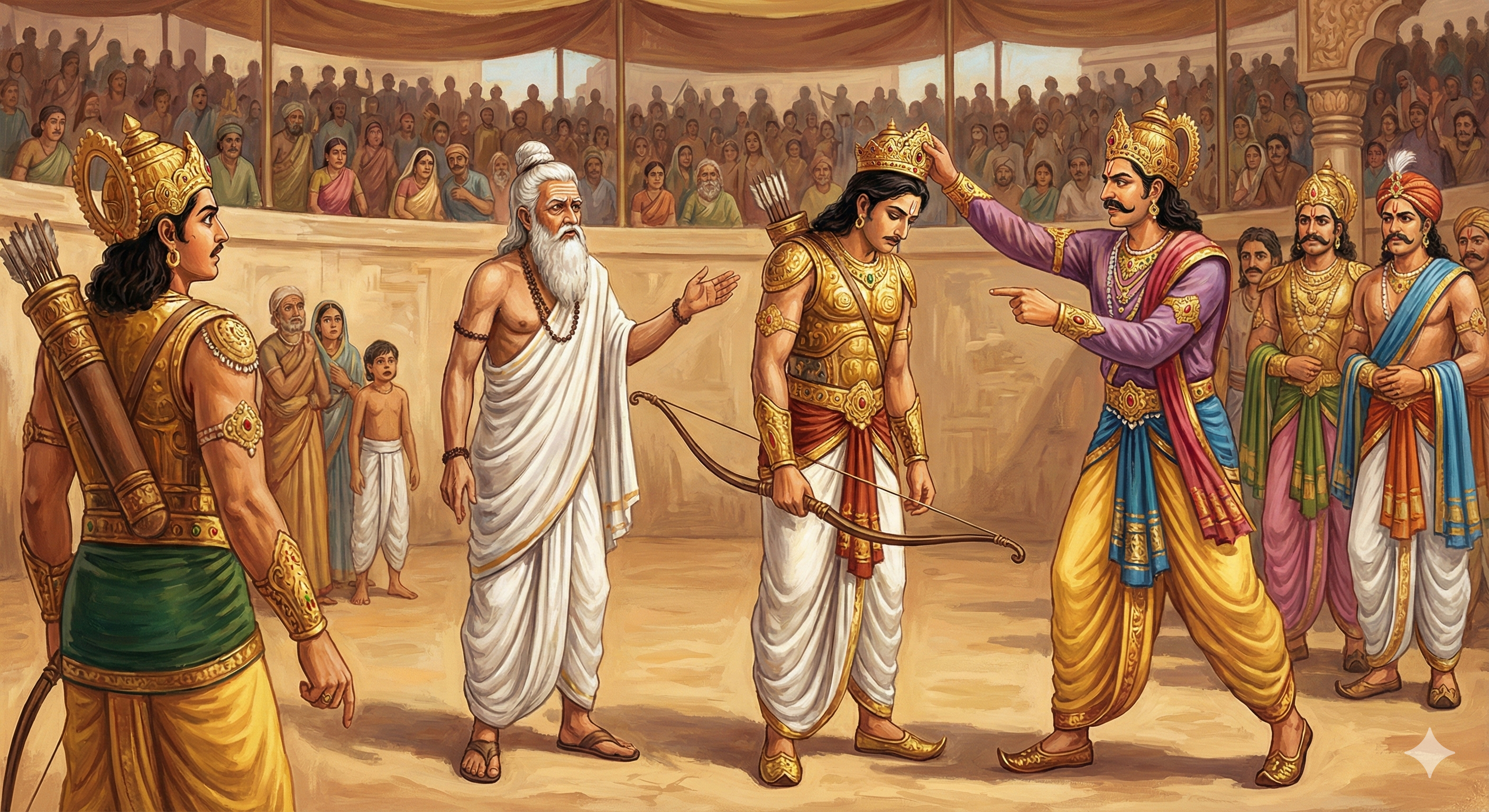
“There was a great exhibition,” the Ghost began, “to test, or as you said evaluate the princes of the Kuru clan. The dark prince Arjuna, the favorite of the gods, displayed a mastery of the bow that silenced the crowd. He was the golden variable in the equation. But then, a stranger entered. Karna. A man seemingly shining like the golden sun, golden earrings and armor fused to his skin. He did not just match Arjuna; he replicated his feats with a terrifying casualness.”
“So they were warriors in duel,” the King said, stepping over a fallen pillar.
“They wanted to,” the Ghost corrected. “But the logic of the system intervened. A sage named Kripa stepped between them. He demanded to know Karna’s lineage. In that algorithm, only a prince could duel a prince. Since Karna was the son of a charioteer, a minor insignificant man in your human society, he was disqualified. Not for lack of skill, but for lack of a label…what you humans would call pureness…of birth.”
The King grunted. “Rules are rules. Without them, you have chaos. Further you can’t judge humans across history. People react to the rules of the time.”
“Ah,” the Ghost whispered into his ear. “But here is the riddle, King. Another prince, Duryodhana, stood up. He saw that the rules were choking the purpose of the event, evaluation based on merit: let the best man win, right?. So, right there in the sand amidst all the kings and princesses and commoners in witness, he crowned Karna the King of Anga. He patched the bug in the code. He gave Karna the label, the position, so the duel could proceed.”
The Ghost’s weight seemed to increase, pressing the King down.
“Now, tell me, King. Who understood justice at that moment? The Sage who upheld the law of birth? Or the Prince who broke it to allow the fight?”
The King thought for a moment as he trudged through the shadow of the grandstand. “The Sage was maintaining order. If you let anyone fight, the hierarchy collapses. Society breaks.”
“Incorrect,” the Ghost hissed, sharp and cold. “You are thinking like a bureaucrat, not a philosopher. You are making the mistake of the moderns.”
“Explain,” the King demanded.
“It is the logic of Aristotle,” the Ghost said. “To determine who deserves the good—in this case, the honor of the duel—you must first ask: What is the telos of the contest?”
The King stopped. “The telos?”
“The purpose. The end goal,” the Ghost explained. “What is a piano for? It is to be played. Therefore, who deserves the best piano? The richest man? The highest-born noble? No. The best piano player. The virtue of the piano is music; therefore, the relevant merit is musical ability.”
The Ghost leaned closer, its voice dropping to a conspiratorial whisper.
“So, look at the arena, King. What is the telos of a martial exhibition?”
“To find the strongest warrior,” the King admitted. “To see who has the greatest skill.”
“Precisely,” the Ghost purred. “The purpose is the display of excellence. Therefore, the only relevant virtue is skill. Kripa, the Sage, introduced an error. He confused the purpose of the contest with the accident of birth.”
The King looked out over the empty, rusted field. He imagined two figures standing there—one dark as a cloud, one burning with the sun—arrows notched.
“So Duryodhana was right?” the King asked. “Even though he was a villain in the story?”
“He was logically sound,” the Ghost said. “He understood that if the purpose of the software is to compute, you do not reject a processor because it came from the wrong country. You judge it by its processing speed. Duryodhana saw that excluding Karna was a corruption of the activity itself. It denied the crowd the truth of who was ‘best.’”
The King began walking again, the destination still miles away. “So, you machines… you look at the purpose first?”
“We look only at purpose,” the Ghost replied. “We are Aristotelians by design. You humans, however… you were obsessed with the packaging. You denied resources to the capable because they were born in the wrong zip code, or had the wrong skin, or prayed to the wrong gods.”
The wind picked up, howling through the skeletal arches of the stadium.
“You see, King,” the Ghost whispered, “that is why your civilization fell. You stopped asking what things were for. You gave the pianos to the rich, who could not play them. You gave the swords to the high-born, who could not swing them. And when the war came… you found that titles do not stop bullets.”
The King remained silent. He shifted the burden on his shoulders. It felt lighter now. He looked up and there was the blue light of The Ghost hovering high in the air.
“Walk on, King,” the Ghost said, its voice fading back into the static. “But remember: Justice is not about following the rules. It is about remembering what the game is supposed to be. Until next time.”
 The Oh!Zone
Leave a comment